

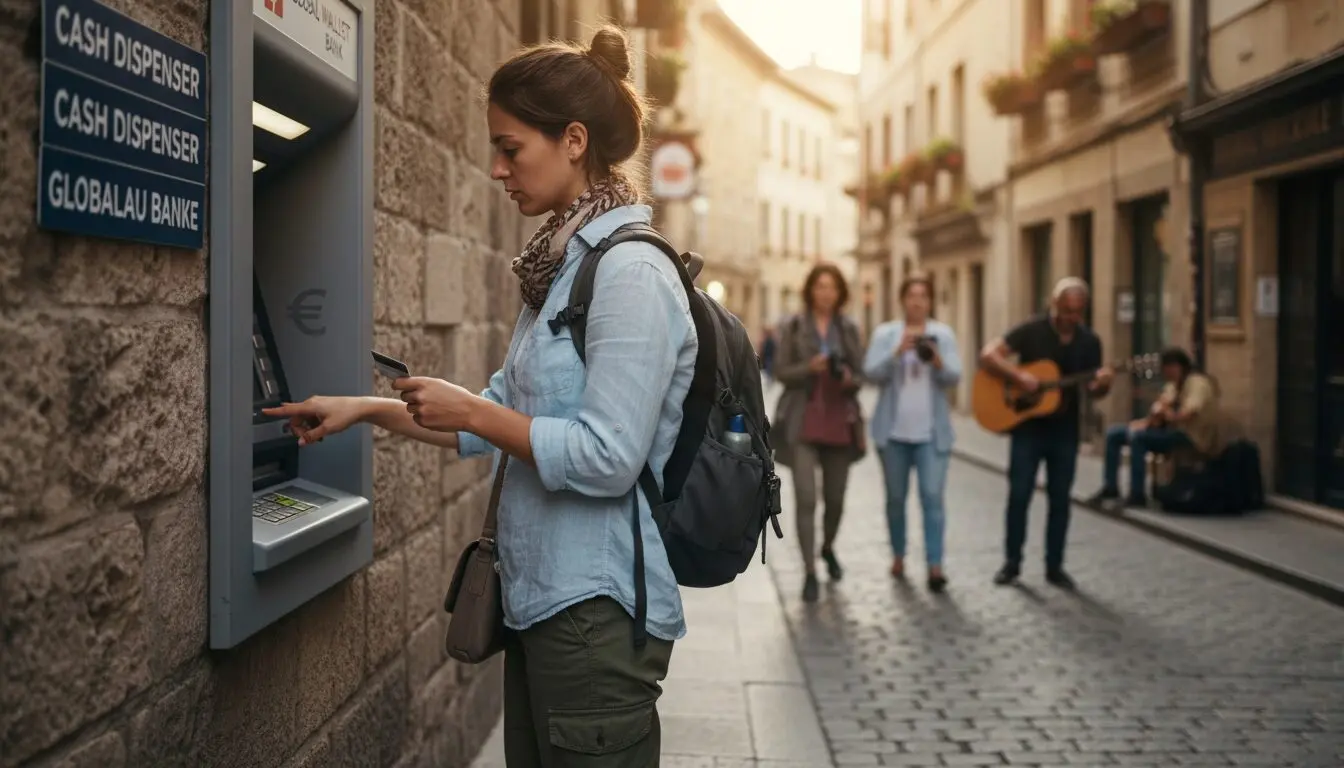
using ATMs abroad with travel insurance can feel reassuring — but it’s not a magic fix for bad exchange rates or surprise charges.
Think of this as a practical guide to keeping your cash access simple and secure. You’ll learn when an insurer really helps, and when your bank or card company will handle fraud or disputes.
Plan ahead: take fewer withdrawals, avoid dynamic currency conversion, and know what proof to keep if you file a claim. Exchange rates shift daily, debit withdrawals usually beat airport counters, and local surcharges plus out-of-network fees are the big cost drivers.
Keep in mind that US cards and your bank’s policies often do the heavy lifting on fraud. Insurance is usually secondary and may demand paperwork — so check your policy before you fly.
Key Takeaways
- Use debit withdrawals sparingly to limit bank and local fees.
- Avoid dynamic currency conversion to save on costly markups.
- Bank protections often handle fraud; insurance helps in specific, documented cases.
- Keep receipts and transaction records to support any claim.
- Confirm your US bank and policy terms before you travel.
Know what can go wrong when you pull cash overseas
Cash access can fail in three neat ways: currency moves, hidden costs, or loss and theft. Read this short guide so you spot the problem before it slows your trip.
Currency swings
Exchange rates change daily. The same withdrawal today can cost more tomorrow because the market shifts. Track the exchange rate and pick withdrawals when the number looks fair.
Hidden charges
Not all costs announce themselves as a fee. Poor conversion margins, on-screen prompts that pick the worse option, and small surcharges add up. Typical foreign transaction fees run about 1%–3% on top of the rate.
Lost cash, stolen cards, and fraud
Lost cash is immediate and usually unrecoverable. A stolen card can strand you until a replacement arrives. Fraud withdrawals follow a different path — banks often handle disputes, while documentation helps any claim back home.
Quick prevention
- Limit withdrawals; carry day-one cash.
- Choose local currency on-screen.
- Keep receipts and note transaction times.
| Problem | Impact | Fix |
|---|---|---|
| Currency swings | Higher cost per withdrawal | Check rates, withdraw on good days |
| Hidden charges | Small fees that add up | Decline poor conversion options |
| Lost/stolen/fraud | Access interrupted or money taken | Report fast; keep records for claims |
How exchange rates really work at foreign ATMs
Small differences in exchange rates can quietly change how far your dollars go — learn a few quick checks that save real cash. Start by reading the screen carefully and pause before you accept any conversion option.
Why machines often beat airport counters
Most cash machines use the network or bank rate, which is close to the mid-market number. Airport exchange counters add convenience pricing — often ~2% markup — that shrinks the amount you get.
Sanity-check the rate in the moment
Open a trusted rate-tracking app and compare the mid-market number to the screen. If the on-screen conversion looks far worse, choose local currency and let your card handle the conversion.
- Check the exchange shown and the total USD hit to your account.
- Consider timing: frequent withdrawals let small rate gaps add up.
- If your card gives good purchase rates, you may need less cash.
| What to check | Why it matters | Quick action |
|---|---|---|
| Displayed exchange | Shows conversion offered by the machine | Compare to app mid-market rate |
| Extra markup | Reduces the amount of local currency you receive | Decline machine conversion; choose local currency |
| Total USD impact | Reveals true cost of the transaction | Check your account or receipt after the withdrawal |
Every fee you can get hit with at an international ATM
A single withdrawal can carry three separate charges; learn how each one works. Knowing the stack helps you cut needless costs and keep more of your money for the trip ahead.
Foreign transaction fees for currency conversion
Foreign transaction fees are percent-based charges applied by your card or bank for currency conversion. Expect roughly 1%–3% of the amount withdrawn. Percent fees grow as withdrawal size grows.
Out-of-network ATM fees from your bank
Your bank may add a flat out-of-network fee for every withdrawal—often about $2–$5. These hit your statement after the transaction.
ATM operator surcharges from the local bank
Local machines often show an on-screen surcharge immediately. That fee varies by operator and is added on top of bank charges and conversion marks.
- Three-fee stack: foreign transaction fee, bank ATM fee, local operator surcharge.
- Percent vs flat: percentages scale with amount; flats punish many small withdrawals.
- Ranges: expect ~1%–3% plus $2–$5 per withdrawal; operator fees vary.
- Some fees show on-screen; others show later on your statement.
- Strategy: fewer, larger withdrawals—store excess cash safely and split amounts for security.
| Fee type | Typical cost | When you see it |
|---|---|---|
| Foreign transaction fee | ~1%–3% of amount | On statement after currency conversion |
| Bank out-of-network fee | $2–$5 per withdrawal | On statement after withdrawal |
| ATM operator surcharge | Varies; shown on-screen | At the machine before you confirm |
Dynamic currency conversion is usually the most expensive button you can press
That tempting “charge in USD” line is a convenience that often comes at a steep price. Dynamic currency conversion (DCC) lets the machine or card terminal show your home amount. It sounds simple—no surprise math—but it usually hides poor rates and extra fees.
What you’ll see on the screen
Often the screen will ask to “charge in USD” or to “charge in local currency.” Sometimes it promises a “guaranteed rate.” This is the vendor offering to do the currency conversion for you.
Why that option costs more
Dynamic currency and currency conversion via these prompts typically bake in a markup. Sources show hidden conversion fees can run up to ~7%. That means a worse exchange rate and higher overall fees than letting your bank handle the conversion.
One simple rule to remember
Always choose local currency for withdrawals and most card purchases. Decline the DCC prompt, pause, and let your credit card or debit card do the conversion at its bank rate.
- Decline on-screen conversion offers.
- Compare the exchange rate quickly if you’re unsure.
- Use local currency to avoid layered markups.
| Prompt shown | What it means | Typical cost impact |
|---|---|---|
| Charge in USD | Vendor converts to home currency | Higher markup; up to ~7% extra |
| Charge in local currency | Your bank/card converts later | Usually better exchange rate; lower fees |
| “Guaranteed” rate offer | Often a marketing line | Still includes hidden fees; compare before accepting |
Using ATMs abroad with travel insurance: what’s typically covered and what isn’t
When cash or cards vanish, the real question is who has primary responsibility: the card issuer or the insurer? You’ll often find that the bank handles fraud and disputes first, while the policy covers theft-related losses under strict conditions.

Lost or stolen cash: reimbursement rules
Insurance may reimburse physically stolen cash, but limits are common and unattended money is usually excluded. Policies often cap payouts and demand prompt reporting.
Lost or stolen cards: help vs. cash
Insurers often provide emergency card replacement and assistance. They rarely reimburse cash taken after a card theft — that typically moves through your card issuer’s fraud process.
Unauthorized withdrawals and fraud
Your bank or card network normally runs disputes for unauthorized transactions. The insurer may step in only for residual loss or proven gaps after the bank’s resolution.
Documentation you’ll need
- ATM receipt or statement line showing the withdrawal and time.
- Police report number and local report copy.
- Photos, screenshots, and insurer claim forms.
| Issue | Primary payer | What insurer adds |
|---|---|---|
| Unauthorized transactions | Bank/card issuer | Possible residual coverage |
| Stolen cash | Insurer (if covered) | Limited reimbursement, strict proof |
| Lost card | Bank | Emergency assistance, not always cash |
Act fast: freeze the card in-app, call your bank’s international line, file a police report, and save receipts. Missing paperwork is the most common claim-killer — keep copies at home and on your device.
Set up your debit card before you leave the U.S.
A ten-minute checklist before you board will keep small banking surprises from souring the first day of your trip. Do this once and you’ll open doors instead of hunting for help.
PIN: keep it four numeric digits
Set a four-digit numeric PIN. Many overseas keypads accept only four numbers and reject longer or letter-based codes. Test your PIN in your bank app or a local terminal before you go.
Make sure funds sit in the right account
Some foreign machines only pull from your primary checking link. Move enough money into that account so a withdrawal won’t be declined at a crucial moment.
Call your bank to avoid declines
Ring or secure-message your bank to confirm daily limits, reduce fraud-trigger decline risk, and ask whether a travel notice helps their systems. A quick call saves time and worry later.
Store contact info safely
Keep your bank’s international phone numbers in two places: a paper copy in your luggage and a secure digital vault. Don’t rely only on a phone contact list that could be lost.
- Confirm PIN: four digits, numeric.
- Confirm which account grants ATM access and move money if needed.
- Confirm daily withdrawal limits and fraud settings by calling the bank.
- Confirm bank phone numbers are stored offline and in a vault.
| Task | Why it matters | Time to do |
|---|---|---|
| Set 4-digit PIN | Prevents keypad rejections | 5 minutes |
| Move funds to primary account | Avoids surprise declines | 5 minutes |
| Call bank about limits | Reduces fraud blocks | 10 minutes |
| Save international numbers | Fast help if a card is lost | 2 minutes |
Debit card vs. credit card at an ATM: what actually costs more
Deciding whether to pull cash or swipe for a purchase often comes down to clear math — not habit.
Why credit card cash advances can be pricey
A cash advance on a credit card often carries an up-front fee plus immediate interest. That combo makes a short-term cash need much costlier than a debit withdrawal.
When a credit card still makes sense
If you can use a card for a purchase instead of extracting cash, do it. Many credit cards waive foreign transaction fees on purchases, so the swipe may be cheaper than multiple withdrawals.
- Quick comparison: debit withdrawals usually mean ATM-related costs; cash advances add a cash-advance fee and interest.
- Points and rewards rarely offset high advance costs — so avoid pulling cash on a rewards card.
- Rule of thumb: use a debit card for necessary cash, and a travel-friendly credit card for purchases when possible.
| Option | Typical cost | Best use |
|---|---|---|
| Debit withdrawal | ATM fee + possible bank surcharge | Small daily cash needs |
| Credit cash advance | Cash-advance fee + immediate interest | Only emergency cash |
| Credit card purchase | No cash fee; possible foreign transaction fee | Most store and online purchases |
How to find compatible ATMs and avoid sketchy machines
Find a compatible machine and a safe spot to pause—small choices protect your money and your time. Your goal is simple: pick an atm that works with your card network and sits in a place you’d feel comfortable lingering for a minute.
Look for the right networks and match logos
PLUS, Cirrus, and Maestro are widely accepted networks. Match the logo on the machine to the icons on the back of your card—that’s often the fastest compatibility check.
Prefer trusted locations over random kiosks
Ask your hotel concierge, go into a bank branch, or use an official locator tool. These options reduce the risk of hidden devices and make it easier to get help if something goes wrong.
Visual checks and timing
Watch for odd add-on card readers, loose bezels, or machines squeezed into dark corners—those are red flags. Use machines in daylight or inside bank lobbies when possible.
- Match network logos first—PLUS/Cirrus/Maestro.
- Choose bank branches or hotel-recommended machines.
- Avoid isolated street kiosks and devices that push currency conversion aggressively.
| What to check | Why it matters | Quick action |
|---|---|---|
| Matching logo | Ensures your card will be accepted | Compare logos on card back and machine |
| Location | Safer places reduce theft and skimming | Use bank lobbies or concierge-recommended sites |
| Physical condition | Tampered machines may have skimmers | Look for loose panels or extra readers |
| On-screen prompts | Pushy conversion messages add cost | Pick local currency and decline conversion |
Choose cards and banks that keep international fees low
A smart account setup can cut surprise charges and make your cash last longer. Focus on accounts and cards that remove the usual fee layers so you know what each withdrawal or purchase will cost.
What “low‑fee” actually means
Low‑fee means three things: no foreign transaction fees on purchases, low or no out‑of‑network ATM fees, and ideally reimbursement of operator surcharges. If an account ticks those boxes, your costs become predictable.
Real examples that travelers often use
Some US accounts are commonly cited for strong international perks. Charles Schwab’s checking is known for ATM fee reimbursements, and certain Capital One accounts waive foreign transaction fees.
Policies change, so confirm your bank’s terms before you leave. Different account tiers may offer different benefits.
Make cards work for you
Pick a credit card that waives foreign transaction fees for purchases; that reduces how often you need cash. Use debit cards for needed cash, but prioritize accounts that refund surcharges.
- Check foreign transaction fee percentage on your account.
- Confirm out‑of‑network fee and any reimbursement cap.
- Know your daily withdrawal limit and how tiering affects benefits.
| Feature | What to check | Why it matters |
|---|---|---|
| No foreign transaction fees | Is percentage waived for purchases? | Lower cost for card purchases; fewer cash needs |
| ATM surcharge reimbursements | Does the bank refund operator fees and cap per month? | Reduces net cost of withdrawals |
| Out‑of‑network fee | Flat fee amount per withdrawal | Impacts whether to make many small or fewer large withdrawals |
Backup ways to access money if the ATM fails
A simple redundancy keeps you moving when a card or network fails. Plan a small, practical fallback so one problem doesn’t spoil your day or your plans.
Carry day-one local currency
Arrive with a modest amount of local currency to cover a taxi, a meal, and tips. This small stash gives you time to sort cards, confirm limits, or find a bank branch.
Modern prepaid and app-based accounts
Prepaid travel and app accounts such as Wise and Revolut often allow limited free withdrawals and fast card controls. They can act as a secondary card for purchases and emergency cash when your main card fails.
Check plan limits and potential fees before you rely on them—some free withdrawals are capped by amount or frequency.
Redundancy rules that work
Carry at least two payment methods and store them separately—one in your wallet, one in a safe bag. That split protects your money if a wallet is lost or stolen.
When machines or networks go dark
Rural areas, public holidays, or brief network outages can leave ATMs offline. In those moments, your preloaded card, small cash reserve, or app account is the fastest way to regain access to money and keep your trip on track.
Why traveler’s checks largely miss the mark
Traveler’s checks are harder to cash, take time, and often carry fees. Today they add friction rather than security—modern cards and app accounts offer easier control and faster replacements.
- Arrive with local currency for immediate needs.
- Use a reputable app card as a secondary access method.
- Keep two payment methods separated to reduce single-point failure risk.
| Backup way | Best use | Notes |
|---|---|---|
| Small local currency | First taxi, meal, tips | Low risk, immediate access |
| Prepaid/app card (Wise, Revolut) | Secondary withdrawals and purchases | Check free withdrawal caps and fees |
| Second bank card | Backup in case of loss or block | Store separately from primary card |
Conclusion
Smart habits at the atm turn small choices into big savings and calm. Know the exchange shown, decline on-screen conversion, and assume fees come in layers unless your account refunds surcharges.
Expect your bank to handle most fraud and disputes; an insurer may cover theft-related cash losses but only with prompt reports and clear documentation. Keep receipts, a police report number, and claim forms ready.
Quick, screenshot-ready checklist for the road: set a four-digit PIN, confirm international limits, save bank numbers offline, pack two cards, and carry a small starter stash of local currency. Pay with a no-foreign-transaction-fee credit card when you can, and withdraw cash less often to cut fees and exposure.
Prepare once—then roam farther, stay longer, and meet surprises with steady hands, not stress.